


GROUNDING: THE SCIENCE BEHIND BALANCE
- Dr. Jen Rochlis

- May 26
- 4 min read
The Earth is like a giant rechargeable battery and part of a global electrical circuit. It takes in energy from the sun and stores it within its biosphere - its plants, animals and all living organisms. This energy is discharged back into the environment when organisms die, and it’s also released through natural processes like volcanic activity or human actions such as deforestation and burning fossil fuels.
Like a battery, the Earth maintains a delicate balance between positive and negative charges. Its surface carries a slight negative charge, while the surrounding atmosphere holds a small positive charge. Lightning is one dramatic example of how this global circuit balances itself, transferring built-up positive charge in the atmosphere to the Earth’s surface. In this way, the Earth acts as a massive grounding system for the planet, maintaining electrical equilibrium.

You’ve seen this concept in action at home. That third prong on your electrical plug? That’s the ground. It ensures that excess charge is safely transferred to the Earth, protecting the circuit—and you—from damage.
Our bodies are remarkably similar. We are also electrical systems, with our cells communicating through the nervous system via electrical impulses—think of your heart beating, your muscles contracting, and even your brain processing thoughts. And like any electrical circuit, our bodies need to stay balanced in terms of charge.

So Why Does Excess Energy Build Up In The First Place?
Historically, humans naturally grounded themselves by walking barefoot, sleeping on the Earth, and maintaining direct contact with nature. In modern life, however, we’ve become increasingly disconnected from this process. Synthetic shoe soles, urban living, and constant exposure to electromagnetic fields (EMFs) from devices like phones, laptops, and Wi-Fi disrupt our natural connection to the Earth.
In addition to EMFs, stress, pollution in our food and water, and even inactivity can cause excess energy to build up in our bodies. Without grounding, this accumulated charge can overburden our nervous system, leading to chronic stress, fatigue, and imbalance.
What’s So Bad About Not Grounding?
When we don’t discharge this excess energy, it affects our bodies at a cellular level. The Earth’s surface is rich in negative electrons, which are transferred to our bodies when we make direct contact with it. These electrons act as natural antioxidants, neutralizing free radicals—unstable molecules that cause oxidative stress and inflammation.
Without grounding, free radicals can overwhelm the body’s repair systems, leading to increased inflammation, DNA damage, and disrupted cellular communication. Over time, this can weaken the nervous and immune systems, leaving the body more vulnerable to chronic disease and fatigue.
THE BENEFITS OF GROUNDING
While modern life has disconnected us from this vital practice, studies show that grounding has immediate and measurable benefits:
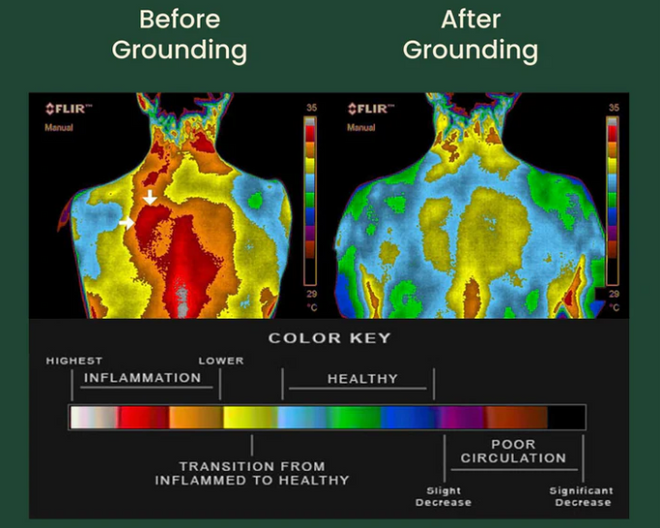
Reduces inflammation and pain: Research published in the Journal of Inflammation Research indicates that grounding can decrease inflammation and pain by improving circulation and neutralizing free radicals. Heat map imaging reveals a significant decrease in inflammation after just a few minutes of grounding.
Source: https://bahe.co/pages/grounding
Reduces inflammation and pain: Research published in the Journal of Inflammation Research indicates that grounding can decrease inflammation and pain by improving circulation and neutralizing free radicals. Heat map imaging reveals a significant decrease in inflammation after just a few minutes of grounding.
Improved sleep and lower cortisol levels: Grounding regulates stress hormones, helping to calm the nervous system and improve sleep. A study in the Journal of Alternative and Complementary Medicine found that grounding during sleep resynchronized cortisol hormone secretion with its natural 24-hour circadian rhythm, which may enhance sleep quality and reduce stress.
Enhances cellular function and wound healing: Case studies have documented accelerated wound healing in individuals who practiced grounding. It helps to improve blood flow and oxygen delivery to the body, suggesting improved immune response and tissue repair. Grounding can help neutralize free radicals, supporting the body’s natural repair processes and reducing oxidative stress.
Syncs our brainwaves to the Earth’s natural frequency: The Earth emits a natural electromagnetic frequency called the Schumann Resonance, which vibrates at approximately 7.83 Hz. This frequency closely aligns with the brain’s alpha waves, associated with relaxation and calmness. Some researchers suggest that grounding may help sync our brainwaves with this natural frequency, promoting a relaxed state and reducing stress.
Boosts overall health: Regular grounding has been linked to improved cardiovascular health, immune function, and emotional well-being.
Grounding in Practice
There are many ways to incorporate this into your routine, see what may work for you:
Walking barefoot on grass, soil, or sand (even briefly in winter, if you can do it safely).
Be near moving water, like a river or ocean (moving water generates negative ions that our bodies can absorb, helping to reduce stress, improve mood, and promote overall balance).
Spending time in nature or gardening.
Using grounding mats or sheets that simulate contact with the Earth’s surface (email me if you’d like recommendations).
Practicing yoga, meditation, or mindfulness with grounding techniques.
Wearing non-rubberized shoes that allow the conduction of negative electrons to your feet.


Comments